Working Together to Make Emergency Communication Accessible in Queensland
How can digital tools help Deaf and hard-of-hearing people access information during emergencies?
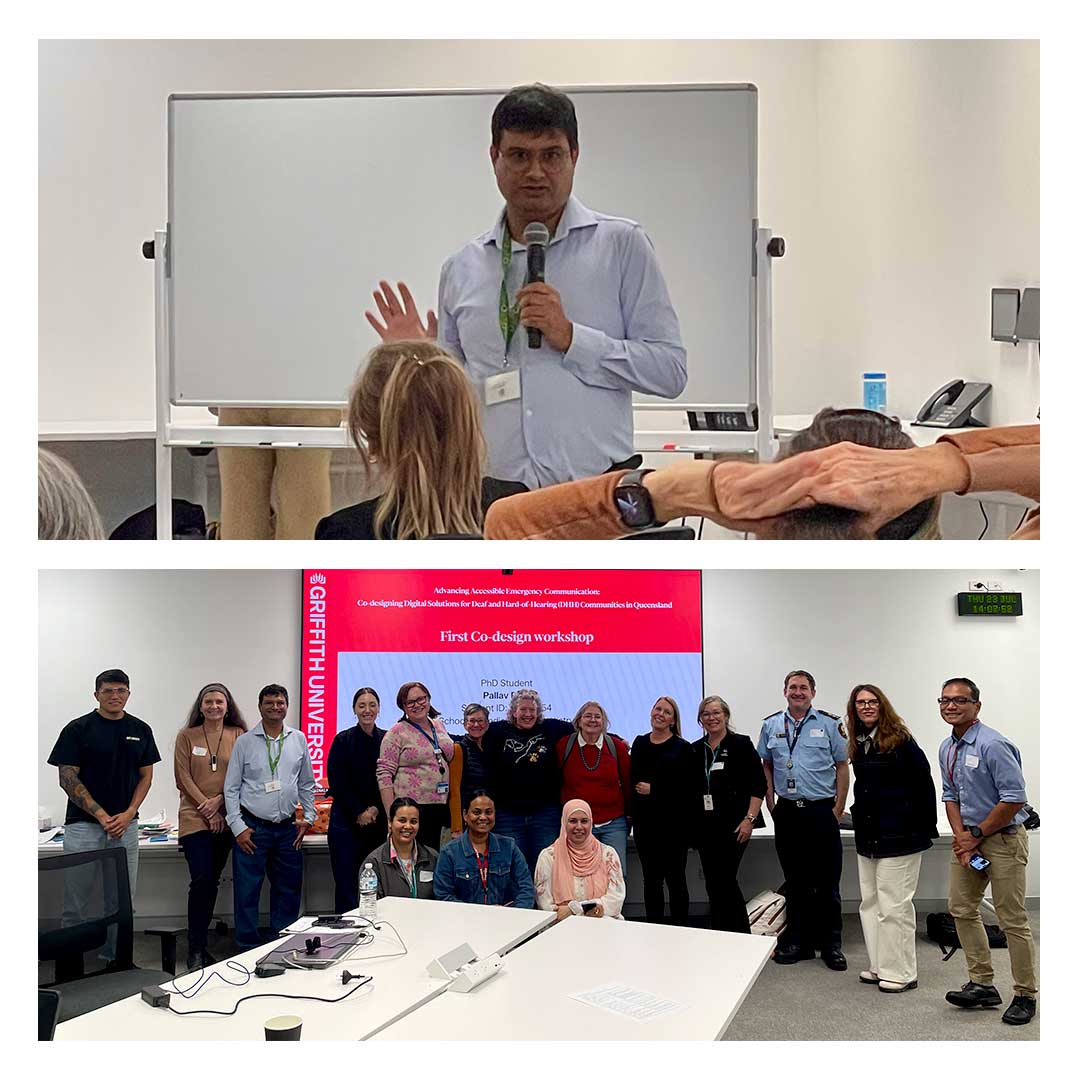
A Griffith University PhD research project explores this question through three co-design workshops. The research is titled “Advancing accessible emergency communication: co-designing digital solutions for Deaf and Hard of Hearing (DHH) communities in Queensland”. The PhD project is led by Pallav Pant, with his supervisory team, Dr Febi Dwirahmadi, Prof. Elizabeth Kendall, Prof. Dian Tjondronegoro and Dr Monique Lewis and research assistant teams.
Each workshop brings together 10 to 13 participants from the Deaf and hard-of-hearing community, first responders, service providers, advocacy organisations, and other stakeholders from across Queensland. Some participants took part in earlier key informant interviews, while others joined the research for the workshops.
Co-design means working together to understand challenges, share ideas and develop solutions with a continuous feedback process. In these workshops, participants helped develop and improve digital communication tools based on the needs and experiences of Deaf and hard-of-hearing people. The aim was to create practical, accessible tools shaped by the people who will use them.
About the workshops
The three workshops took place at the Disaster and Emergency Management Unit on the Gold Coast. Each workshop lasted four hours, including morning tea and lunch.
- Workshop 1 — 23 July 2026: Participants explored emergency communication challenges and community needs. They also had an opportunity to tour the facility and learn more about its role in disaster management.
- Workshop 2 — 27 August 2026: Participants reviewed early versions of the digital tools and shared feedback.
- Workshop 3 — 29 September 2026: Participants assessed and refined the proposed solution. They also identified additional needs that the prototype did not yet address.
Supporting participation
Auslan interpreters, closed captioning and accessible materials supported communication throughout the workshops. Different communication methods helped participants share their ideas and take part in discussions.
Deaf and hard-of-hearing participants received a gift card for each workshop they attended, in appreciation of their time and contributions.
Participants’ contributions are de-identified and treated confidentially. This project is supported by a scholarship funded by Griffith University and Natural Hazards Research Australia (NHRA). The research has received Griffith University Human Research Ethics approval (reference: 2025/808).

Thank you for your contribution!
Help us reach out to more people in the community
Share this with family and friends